
One Learning Theory per Book: How the Joghdi & Fili Persian Series Is Designed
Most children's language books are written and then explained. This series was explained and then written. Each volume of Learn Persian with Joghdi and Fili is built around a different, named theory of how children acquire language, and each book states which one in its own introduction. This article sets out what that meant in practice — not a summary of the theories, but the specific design decisions each one forced, shown with pages from the books themselves.
Written by the curriculum team at Online Persian School, London, Ontario. The series is published by Joghdi Publishing, our sister publishing house.
Why publish the design rationale at all
Publishers rarely explain why a children's book is shaped the way it is. The reasoning stays with the author, and the parent judges the result by its illustrations. We took a different approach for a practical reason: the families we work with are not choosing between a good Persian book and a bad one. They are usually choosing between a Persian book and nothing, and what they need to know is whether the thing in their hands was designed by someone who understands how a five-year-old acquires a second language.
Stating the theoretical basis inside each book is our answer to that. It is also a constraint on us. A book that names its own principle can be checked against it — which is why the pages below are reproduced rather than described.
Each volume surfaces one reason the series works, in its own introduction. Three books, three principles. The content is cumulative — letters and vocabulary build across the series — but each volume makes a different design idea visible.
Book 1 — Who Is There? (کی آنجاست؟)
Ausubel (1968) argued that new material is retained when it can be attached to an existing structure, rather than learned as a set of unrelated items. Content-based instruction research reaches the same conclusion from the classroom side: vocabulary taught inside meaningful content is held better than vocabulary taught as a list (Brinton, Snow & Wesche, 2003).
What this forced: the vocabulary in this book is not a beginner word list. It is a single semantic field — farm animals — carried by one story, so each new word arrives already connected to the others.
What it ruled out: the conventional first-book structure of ten unrelated everyday nouns, which is easier to write and easier to forget.
Book 2 — You Good, Fili? (خوبی فیلی؟)
Krashen's (1982) input hypothesis holds that acquisition happens when a learner meets language slightly beyond their current level but still understandable, in a low-anxiety setting. It is among the most influential frameworks in the field, and also a contested one — it has long been criticised as difficult to test directly. We treat it as a well-supported orientation rather than a proven law.
The design question it raises is blunt: how do you guarantee a five-year-old understands a Persian sentence they have never heard?
خوبی؟
You good?
زندهای؟
Are you alive?
Two words each. Both fully recoverable from the picture: a sleeping elephant, an owl leaning over him, and — by the second question — a stethoscope and an open first-aid kit.
What this forced: utterances short enough that the illustration can carry their entire meaning. Nothing in this book asks the child to hold a sentence in working memory while decoding it — if the picture cannot deliver the meaning, the line is too long and gets cut.
It also forced the bilingual page structure described further down, which is what makes the Persian comprehensible by construction rather than by luck.
What it ruled out: explicit grammar explanation, translation glossaries at the foot of the page, and any exercise that asks for production before the pattern has been met repeatedly.
Book 3 — The Friendship Balloon (بادکنک دوستی)
Bandura (1977) held that much behaviour is acquired by watching and imitating a model rather than by instruction. Applied to language, this predicts that a child will reproduce speech they have seen someone they like produce, in a situation they understood.
That imposes a requirement most picture books do not meet: the target language has to be performed by a character, in a complete exchange, rather than reported by a narrator.
این رُبات رو دوست داری؟
Do you like this robot?
این خِرسی رو دوست داری؟
Do you like this teddy?
Two pages apart. The frame is identical; one word changes.
What this forced: the language of this book is carried almost entirely by dialogue between two characters rather than by narration. Joghdi asks, offers, and waits; Fili answers. The child watches a whole speech act performed by a character they like, which is the condition Bandura's account requires for imitation — not merely exposure to a phrase.
The repeated frame does a second job. Because only the noun changes, the child hears the question as a reusable pattern rather than a fixed phrase, and the toys — robot, teddy, and the rest — form one semantic field, so the same page is doing Ausubel's work at the same time. The principles are cumulative across the series; each volume simply makes one of them visible.
What it ruled out: a descriptive story in which the vocabulary appears but nobody is shown using it.
What all three volumes share
Every page appears twice, in two languages
The most consequential design decision in the series is not specific to any one volume. Each illustration appears twice in sequence: once carrying the English line, once carrying the Persian. The child meets the moment in the language they already command, so the meaning is secured before the Persian arrives. When the Persian page turns, nothing has to be decoded — the scene, the joke and the question are already understood, and the Persian sentence maps onto meaning the child is holding.
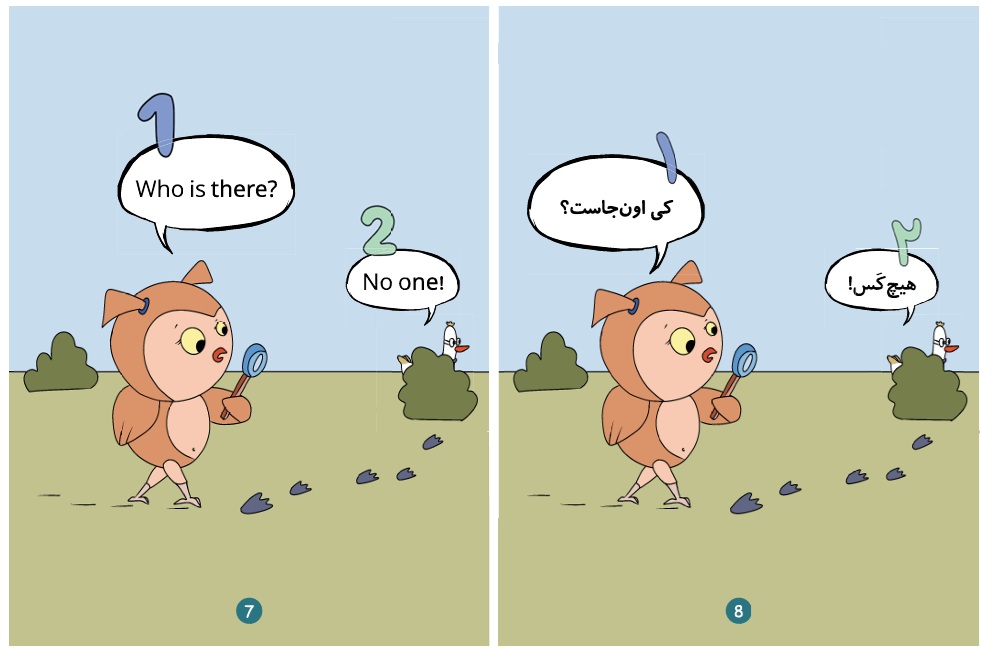
A second detail on those pages is easy to miss. The speech bubbles are numbered, so a child who cannot yet read knows which one comes first — and in the Persian version the numerals are Persian, so the digits are met in passing rather than taught as a separate lesson.
The books are funny, and that is doing work
On the pages above, Joghdi follows a trail of footprints, raises a magnifying glass and asks who is there. A bird sitting in plain view in the bush answers: هیچکَس! — "No one!"
The jokes also build. In You Good, Fili?, Joghdi finds Fili asleep and asks whether he is all right. He does not answer. So she escalates: out comes a stethoscope, and the question becomes زندهای؟ — "Are you alive?" The second joke only works if the child followed the first.
Humour in a language book is usually treated as decoration. In this design it is load-bearing, for three reasons.
Two of them follow from the theories the series is built on. Krashen's (1982) account includes an affective dimension: anxiety impedes acquisition, and a relaxed, enjoyable encounter with the language lets more of it through. And in Bandura's (1977) terms, a child imitates a model they find appealing — a funny character is a more powerful model than a merely instructive one.
The third is more useful to a parent. A joke is a comprehension check that does not feel like one. A child cannot laugh at the stethoscope without having understood that Fili was asleep and would not answer. Laughter is evidence that the input landed — and unlike a quiz, it costs the child nothing and tells the adult something real.
There is also a blunter mechanism behind all three. A child who laughs asks for the book again. Repetition is what makes the patterns stick, and a joke buys that repetition without anyone having to insist on it.
What this design does not claim
Three limits, stated because a page that claims a scientific basis invites the question.
The books cite theory; they do not report measured outcomes. We can say the series is designed around these principles. We cannot say it produces a given gain in a given time, because we have not run the study that would show it, and neither has anyone else on Persian specifically.
Persian is under-represented in this literature. The heritage-language and second-language acquisition research informing these decisions is dominated by Spanish, Russian, Chinese and Turkish. Applying it to Persian-speaking children abroad is a reasonable inference, not a demonstrated result.
The theories are not equally settled. Ausubel's and Bandura's frameworks are long established across educational psychology. Krashen's input hypothesis is enormously influential but genuinely disputed within second-language acquisition. We use it because it describes what we observe; we do not present it as beyond argument.
How the books and the classes relate
The same principles run through both, but they are not the same object. A book is a fixed artefact that must work without a teacher present; a lesson can adapt in real time to the child in front of it. A principle that shapes a page differently from how it shapes a class is doing its job.
Our companion article on how Persian tutors should teach Farsi to kids covers the classroom side — six principles including these three, and what each looks like in a live lesson.
The series continues
Three of a planned twenty volumes in the Joghdi and Fili series are published, with a second series for older children in preparation. Each new volume surfaces a further principle, and this page will be extended as they appear rather than rewritten. The structure is deliberate: a reader should be able to see, book by book, which idea each one was built on.
References
- Ausubel, D. P. (1968). Educational Psychology: A Cognitive View. New York: Holt, Rinehart & Winston.
- Bandura, A. (1977). Social Learning Theory. Englewood Cliffs, NJ: Prentice-Hall.
- Brinton, D. M., Snow, M. A., & Wesche, M. B. (2003). Content-Based Second Language Instruction. Ann Arbor: University of Michigan Press.
- Krashen, S. D. (1982). Principles and Practice in Second Language Acquisition. Oxford: Pergamon.
- Montrul, S. (2016). The Acquisition of Heritage Languages. Cambridge: Cambridge University Press.
- Polinsky, M. (2018). Heritage Languages and Their Speakers. Cambridge: Cambridge University Press.
See the books
All three volumes are available in hardcover and paperback. Each book page lists the age range, the letters taught, and the principle that volume was built on.
The same principles shape our classes. If you would rather see them in a lesson than on a page, the first week is free.
Published by Joghdi Publishing, our sister imprint.