
How Persian Tutors Should Teach Farsi to Kids: Six Evidence-Based Methods
Discussions of how to teach Farsi to children abroad usually begin with the wrong question. They ask which method is best, when the prior question is which learner is in the room. A child who hears Persian daily at home and answers in English is not doing the same cognitive work as a child meeting the language for the first time, and one method applied to both will underserve one of them. This article sets out six principles for teaching Persian to children, each grounded in the second-language acquisition and heritage-language literature. Alongside each principle we include an unprompted observation from a parent at Online Persian School, as an illustration of the principle in practice.
Written by the curriculum team at Online Persian School, London, Ontario.
The prior question: which learner?
Children who arrive in a Farsi class abroad fall into two broad profiles, and the distinction is not cosmetic. The first is the heritage learner: a child raised in a household where Persian is spoken, who understands a great deal, has age-appropriate pronunciation, and yet produces little or nothing. The second is the foreign-language learner: a child, often from a mixed or non-Persian-speaking home, meeting the language as genuinely new material.
Heritage speakers have been the subject of a substantial research literature over the past two decades, and its central finding is that they are neither native speakers nor ordinary second-language learners but a distinct population: strong receptive ability and pronunciation, uneven morphology and vocabulary, and highly variable literacy (Polinsky, 2018; Montrul, 2016). Teaching such a child from a beginner textbook wastes the receptive knowledge they already hold; teaching a foreign-language learner as though that knowledge were present sets them up to fail.
A further point shapes how a Persian tutor should speak to families. The scholarly consensus has moved away from describing heritage grammars as deficient versions of the homeland variety. Kupisch and Rothman (2018) argue that difference is not incompleteness, and that early child bilinguals are properly understood as heritage speakers with their own systematic competence. A tutor who treats a child's Farsi as broken teaches shame alongside vocabulary. A tutor who treats it as a real, partial system that can be extended teaches the language.
"What makes this work so well, in my opinion, is the founders' mastery of pedagogy and early childhood development. Having a background in education myself, I can see the way they embrace research and best practices from the fields of instructional design and childhood development to implement models of learning that are highly effective. The lesson plans are engaging, age appropriate, and well organized."— Shiva Darbandi, parent, Facebook review
Six principles for teaching Farsi to children
1. Comprehensible input comes before production
Krashen's (1982) input hypothesis holds that acquisition proceeds when learners understand language slightly beyond their current level. Practically, this means the tutor speaks Persian a great deal, in short and highly contextualised utterances, and does not demand output before the child has heard the pattern many times. For heritage learners in particular, silence in early lessons is often not incomprehension but reluctance, and pressure converts reluctance into refusal.
Two qualifications are owed to the reader. Krashen's framework is among the most influential in the field and is taught worldwide, but it has been criticised for decades on the grounds that its core claims are difficult to test directly. It is best treated as a well-supported orientation rather than a settled empirical law, and it does not entail that output is unimportant. In our practice, input dominates the opening of a course and gives way to structured production as comprehension consolidates.
"My son is LOVING his class so far! They put effort into the curriculum and my son who understands Farsi but previously had no interest in speaking it now wants to talk as much as he can!"— Nava Ghalili, parent, Google review
"My 5-year-old son started with just a few words in Farsi and was resistant to learning, insisting English was his only language… After just 5 months with Ms. Shohreh Sharifi, he knows so many words, is more confident, and even enjoys Farsi now!"— ZS Bu, parent, Google review
2. Total Physical Response (TPR) and multimodal learning
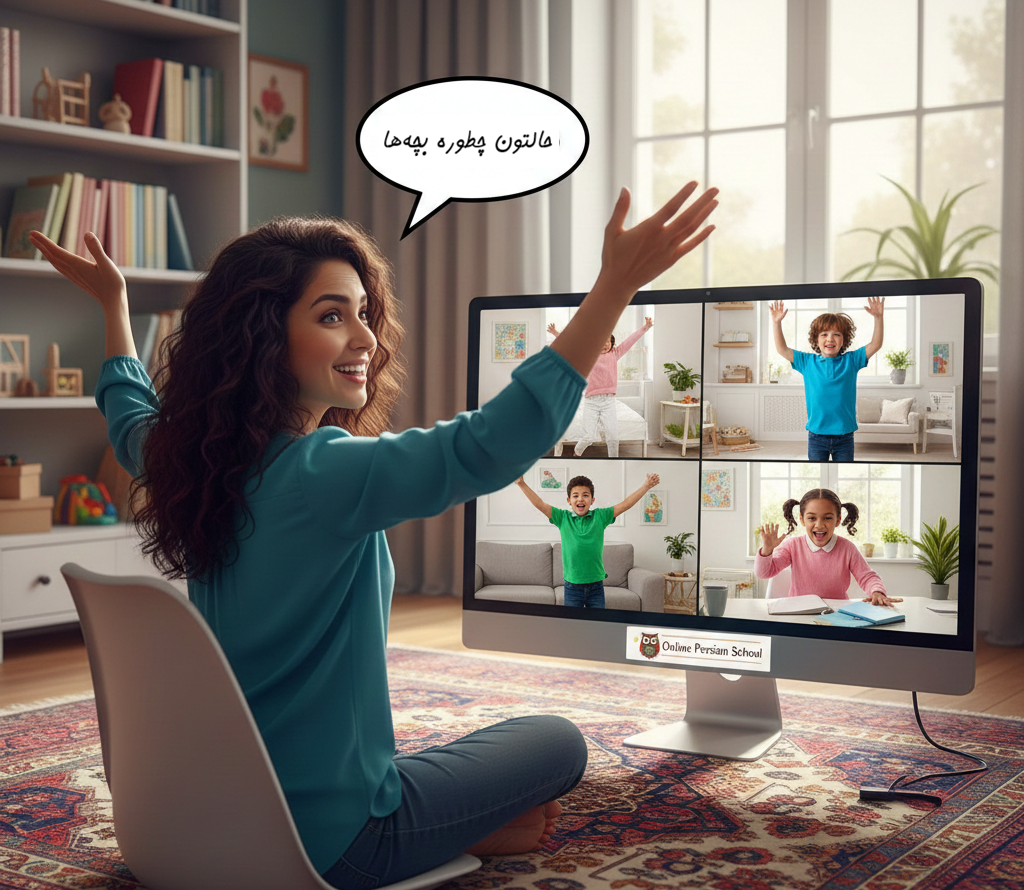
Total Physical Response, developed by Asher (1969), pairs commands with physical action: the child hears a Farsi instruction and performs it, long before being asked to say anything. With young learners it works, and it works well in an online lesson, where a webcam makes movement a shared activity rather than a distraction.
Our teachers mime action verbs rather than translating them. A new verb is introduced three times before the child is asked to produce anything: the teacher performs it while saying it; then performs it again with the child copying; then gives the instruction and waits while the child performs it alone. Only after that is the child invited to say the verb — and later to give the instruction back to the teacher, a reversal children find funny and consequently remember. Verbs such as بپر (jump), بشین (sit down), دست بزن (clap) and بخند (laugh) are taught this way and never appear as a vocabulary list to be memorised.
The reason TPR works is frequently misstated. Movement does not aid memory because it "activates the right hemisphere of the brain." The left-brain/right-brain division of labour is a durable popular myth and does not describe how language is processed. The defensible mechanism is multimodal encoding: information registered through more than one channel is stored more robustly than information registered through one. Paivio's (1986) dual coding theory formalised this for verbal and imaginal codes, and experimental work has since extended it to gesture and enactment in foreign-language vocabulary learning specifically, finding that words trained with accompanying gestures are retained better over long intervals than words trained without them (Macedonia, 2011; Macedonia & Klimesch, 2014).
"He's made a lot of progress in a short period of time and looks forward to his lessons. The Iranian side of the family is amazed at how he can recite songs already."— Betsy Okunhon, parent (France), Google review
3. Vocabulary should be organised into meaningful topics
Ausubel (1968) argued that new material is retained when it can be anchored to existing structure, rather than learned as isolated items. Applied to a children's Persian curriculum, this means teaching the words for farm animals, or toys, or family members as a connected set embedded in a story, rather than as a list to be memorised. Content-based approaches to second-language instruction rest on the same logic: language taught through meaningful content is learned more durably than language taught as an object in itself (Brinton, Snow & Wesche, 2003).
"What I particularly appreciate is how Persian culture and heritage are woven naturally into the lessons. Children learn not only the language, but also gain an appreciation for Persian literature, traditions, and cultural values in an engaging and age-appropriate way."— Naz Diva, parent, Google review
4. Children learn to speak by watching someone speak
Bandura's (1977) social learning theory holds that a great deal of behaviour is acquired through observation and imitation rather than direct instruction. For language teaching this argues for modelled dialogue: the child should repeatedly witness two characters, or the tutor and a puppet, greeting one another, asking questions and expressing needs, in exchanges that recur with small variations. Predictable, likeable models matter here — a child imitates a character they are fond of.
"My elementary aged kids have a wonderful teacher who goes over Farsi vocabulary words and phrases using a variety of engaging videos, pictures and songs. My kids even love the fun owl puppet that joins the lessons from time to time."— Nazak Noorian, parent, Google review
5. Young learners are not small adults
Pedagogy for children has its own literature, and it is not a simplification of adult methodology. Pinter (2017) surveys the field, and the recurring themes are familiar to anyone who has taught a six-year-old online: attention spans measured in minutes, meaning carried by activity rather than explanation, grammar acquired implicitly rather than stated, and motivation that depends heavily on enjoyment and on the adult's warmth. A lesson plan that does not change activity every few minutes will not survive contact with the learner.
"Every lesson is delivered with patience, kindness, and a sense of fun that keeps children engaged and motivated. Students and families are encouraged to learn at their own pace, ensuring that each lesson is fully understood before moving on… The lessons are thoughtfully designed, highly engaging, and paced perfectly for young learners."— Naz Diva, parent, Google review
"My half Iranian children love their online farsi class. They both seem to cheer up as soon as it's Farsi time. Very interactive and engaging considering it's online. They manage to engage a 3 and a 5 year old very well."— Nessa Saniee Armstrong, parent, Facebook review
6. Literacy transfers across languages
Parents frequently worry that Persian literacy will compete with school literacy in English. The interdependence hypothesis argues the opposite: proficiency developed in one language supports development in the other, because a common underlying proficiency serves both (Cummins, 1979). Learning to decode the Persian alphabet is not time taken away from English reading; it is practice in the general skill of mapping symbols to sounds, applied to a second script.
"Initially, I was somewhat hesitant about enrolling him in online classes… However, I am delighted to report that my son has made remarkable progress during this time, now demonstrating the ability to write in Farsi."— Asal Elahi, parent, Google review
What this looks like in one lesson
The principles above are not a menu from which a Persian tutor selects one. In a well-constructed 55-minute lesson for a young learner they operate together, roughly in this order:
- Opening routine in Farsi only, unchanged week to week, so comprehension is immediate and confidence starts high.
- Physical response segment: instructions performed, not translated, with the tutor modelling first.
- Story or dialogue in which target vocabulary appears embedded in a topic, with characters modelling the exchange the child will later produce.
- Guided production, invited rather than demanded, with the tutor supplying the frame and the child supplying one word.
- Two letters of the Persian alphabet, traced and recognised, connected explicitly to words already met in the story.
- A closing game the child can play again with a parent, which is where the lesson's effect on home language use is actually decided.
"My six year-old really seemed to be struggling with speaking more than a few words in Farsi. After about two weeks of lessons, there was a significant improvement in her ability to communicate in Farsi. We have had about two months of lessons now, and the results are spectacular. She is speaking in full sentences with her relatives and conjugating verbs."— Shiva Darbandi, parent, Facebook review
What the evidence does not establish
Three honest limits are worth stating, because practitioner writing in this field routinely omits them.
First, none of the principles above has been tested specifically on Persian heritage learners at scale. The heritage-language literature is dominated by Spanish, Russian and Chinese; Persian is comparatively under-researched, and applying general findings to it is a reasonable inference rather than a demonstrated result.
Second, the parent observations quoted throughout this article are illustrations, not evidence of effectiveness. They are unprompted and independent, which is their value, but they are also self-selected — families who are dissatisfied are less likely to write — and they were not collected to answer the questions asked here.
Third, the largest single determinant of whether a child maintains Farsi is almost certainly not the teaching method at all. It is the quantity and quality of language the child encounters at home, and the family's sustained decision to keep using it. A weekly lesson supports that; it does not replace it.
References
- Asher, J. J. (1969). The Total Physical Response approach to second language learning. The Modern Language Journal, 53(1), 3–17.
- Ausubel, D. P. (1968). Educational Psychology: A Cognitive View. New York: Holt, Rinehart & Winston.
- Bandura, A. (1977). Social Learning Theory. Englewood Cliffs, NJ: Prentice-Hall.
- Brinton, D. M., Snow, M. A., & Wesche, M. B. (2003). Content-Based Second Language Instruction. Ann Arbor: University of Michigan Press.
- Cummins, J. (1979). Linguistic interdependence and the educational development of bilingual children. Review of Educational Research, 49(2), 222–251.
- Krashen, S. D. (1982). Principles and Practice in Second Language Acquisition. Oxford: Pergamon.
- Kupisch, T., & Rothman, J. (2018). Terminology matters! Why difference is not incompleteness and how early child bilinguals are heritage speakers. International Journal of Bilingualism. https://doi.org/10.1177/1367006916654355
- Macedonia, M. (2011). Body in mind: How gestures empower foreign language learning. Mind, Brain, and Education, 5(4).
- Macedonia, M., & Klimesch, W. (2014). Long-term effects of gestures on memory for foreign language words trained in the classroom. Mind, Brain, and Education, 8(2). https://doi.org/10.1111/mbe.12047
- Montrul, S. (2016). The Acquisition of Heritage Languages. Cambridge: Cambridge University Press.
- Paivio, A. (1986). Mental Representations: A Dual Coding Approach. New York: Oxford University Press.
- Pinter, A. (2017). Teaching Young Language Learners (2nd ed.). Oxford: Oxford University Press.
- Polinsky, M. (2018). Heritage Languages and Their Speakers. Cambridge: Cambridge University Press.